Adding more workloads
Now that we've set up the foundation of the App of Apps pattern, we can add the additional workload Helm charts to the Git repository.
The repository structure will look like this after adding the application charts:
.
|-- app-of-apps
|   |-- ...
|-- carts
|   `-- Chart.yaml
|-- catalog
|   `-- Chart.yaml
|-- checkout
|   `-- Chart.yaml
|-- orders
|   `-- Chart.yaml
`-- ui
    `-- Chart.yaml
Let's copy the application chart files to our Git repository directory:
Next, commit and push these changes to the Git repository:
Sync the workload applications:
We sync the workload applications directly here, not the parent apps application. Syncing the parent would re-apply the same five Application resources it already created — nothing in its output changed, because this commit added the workload charts, not the App of Apps configuration.
Each workload application tracks its own path in the repository, so they are the ones that need to notice the new commit. Argo CD polls Git roughly every three minutes, and syncing forces that check immediately rather than waiting for the next poll.
When Argo CD completes the process, all our applications will be in the Synced state as shown in the Argo CD UI:
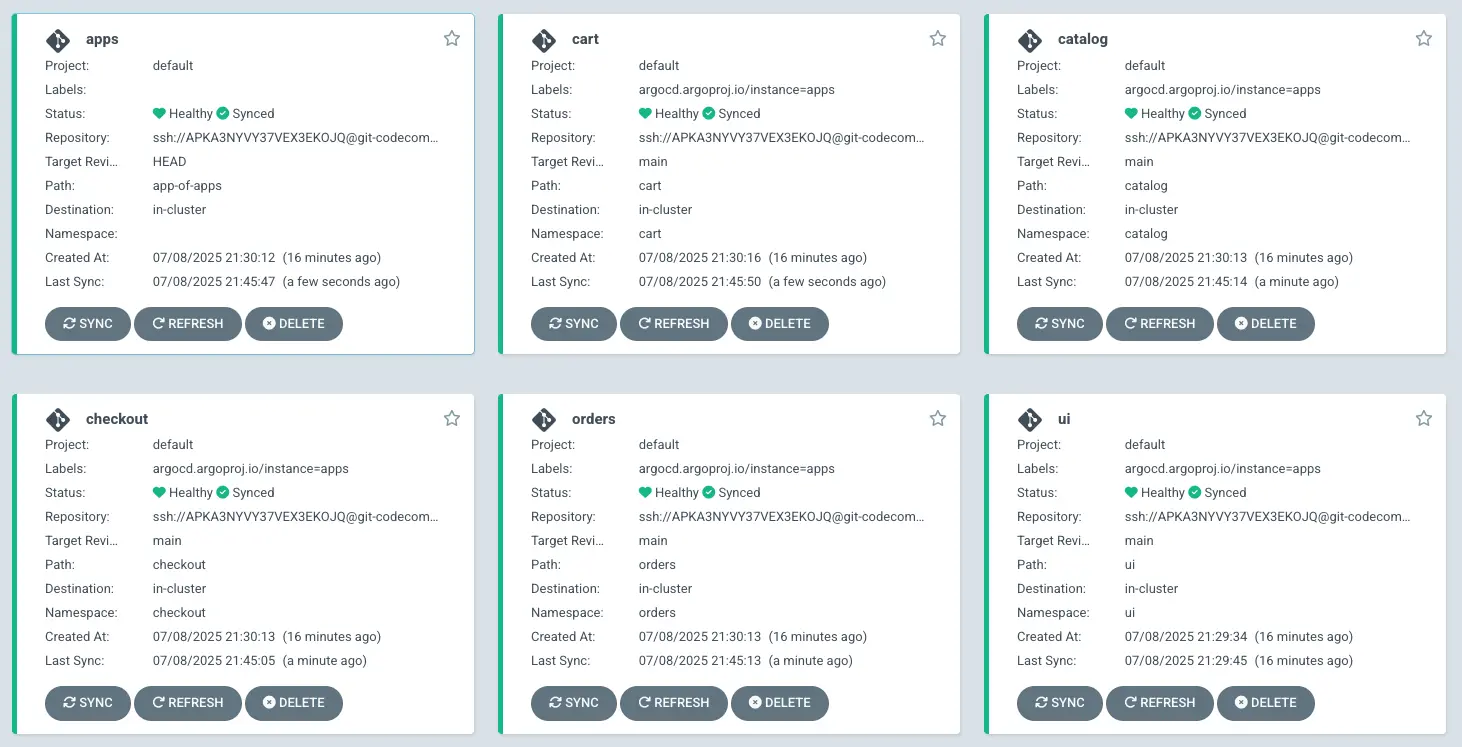
We should now see a set of new namespaces with each application component deployed:
NAME STATUS AGE
carts Active 28s
catalog Active 28s
checkout Active 28s
default Active 8h
kube-node-lease Active 8h
kube-public Active 8h
kube-system Active 8h
orders Active 28s
ui Active 11m
Let's examine one of the deployed workloads more closely. For example, we can check the carts component:
NAME READY UP-TO-DATE AVAILABLE AGE
carts 1/1 1 1 46s
This confirms that our GitOps-based deployment using the App of Apps pattern has successfully deployed all microservices to our cluster.